Fundamental discovery
Collide or scatter particles to probe matter, forces, and the early universe.
To our knowledge, the first foundation model for particle-accelerator telemetry.
A self-supervised transformer learns one shared representation from five accelerators—even as sensor sets change—and transfers it to reconstruction and operational diagnostics.
The linked PDF and OpenReview record are the earlier ICML 2026 workshop version; the NeurIPS proceedings PDF is not yet included in this repository.
Particle accelerators · a primer
Simplified accelerator beamline
Accelerators at scale
Particle accelerators use electric fields to increase the energy of charged particles and magnetic fields to bend, steer, and focus them into controlled beams. Flagship research accelerators are billion-dollar scientific facilities whose thousands of components must operate together with extraordinary precision.
At Los Alamos, the backbone of LANSCE is an 800 MeV linear accelerator approximately one kilometer long; at CERN, the Large Hadron Collider guides protons and ions around a 27-kilometer ring. Continuous diagnostics and control systems keep these enormous machines stable, safe, and useful for experiments.
Applications
Collide or scatter particles to probe matter, forces, and the early universe.
Treat cancer with particle beams and produce radioisotopes for imaging and therapy.
Use intense x-rays and neutrons to resolve structures and follow fast processes.
Inspect components, modify materials, sterilize products, and image concealed objects.
Facilities represented in this study
Research at a glance
Motivation
Successful models target individual facilities and tasks. Yet accelerators reuse related RF, magnet, vacuum, timing, diagnostic, and control systems—an opportunity to learn once and transfer.
Data challenge
Sensor sets and ordering, sampling rates, window lengths, physical units, noise, and operating conditions vary across facilities, subsystems, and acquisitions.
Shared backbone
SensOFormer encodes channels as a set, models their temporal context, and learns by reconstructing clean values from masked, noisy telemetry.
Evidence
Across five facilities, SensOFormer leads 21 of 24 zero-shot imputation settings, passes 20 of 21 early-fault tests, and reaches 84.80% / 84.01% cavity / fault accuracy.
The challenge
Why standard fixed-channel assumptions break down in facility-scale telemetry.
A channel’s meaning comes from its sensor, physical location, and subsystem—not its column index. The observed channels can change between acquisitions, while each subsystem evolves on its own time scale.
Channels range from one to 1,754 in the LANSCE corpus, with no fixed global layout required by the model.
Fast RF and beam events coexist with slower vacuum, cooling, and power-supply behavior.
Isolated dropouts, missing intervals, unavailable channels, and structured gaps all occur in operation.
Configurations, calibration, component aging, and operating conditions shift the sensor distribution over time.
The method
SensOFormer combines permutation-invariant sensor encoding, latent temporal processing, and permutation-equivariant reconstruction. The result is one architecture that accommodates different channel sets and sequence structures without channel-dimension padding.
Corrupt visible telemetry with point, time, channel, or block masks plus sampled Gaussian noise.
Learnable latent queries cross-attend to channel tokens, independent of their input ordering.
A latent transformer processes the compact sequence to learn structure across time.
Reconstruct queried channels or attach a lightweight head for binary and multiclass tasks.
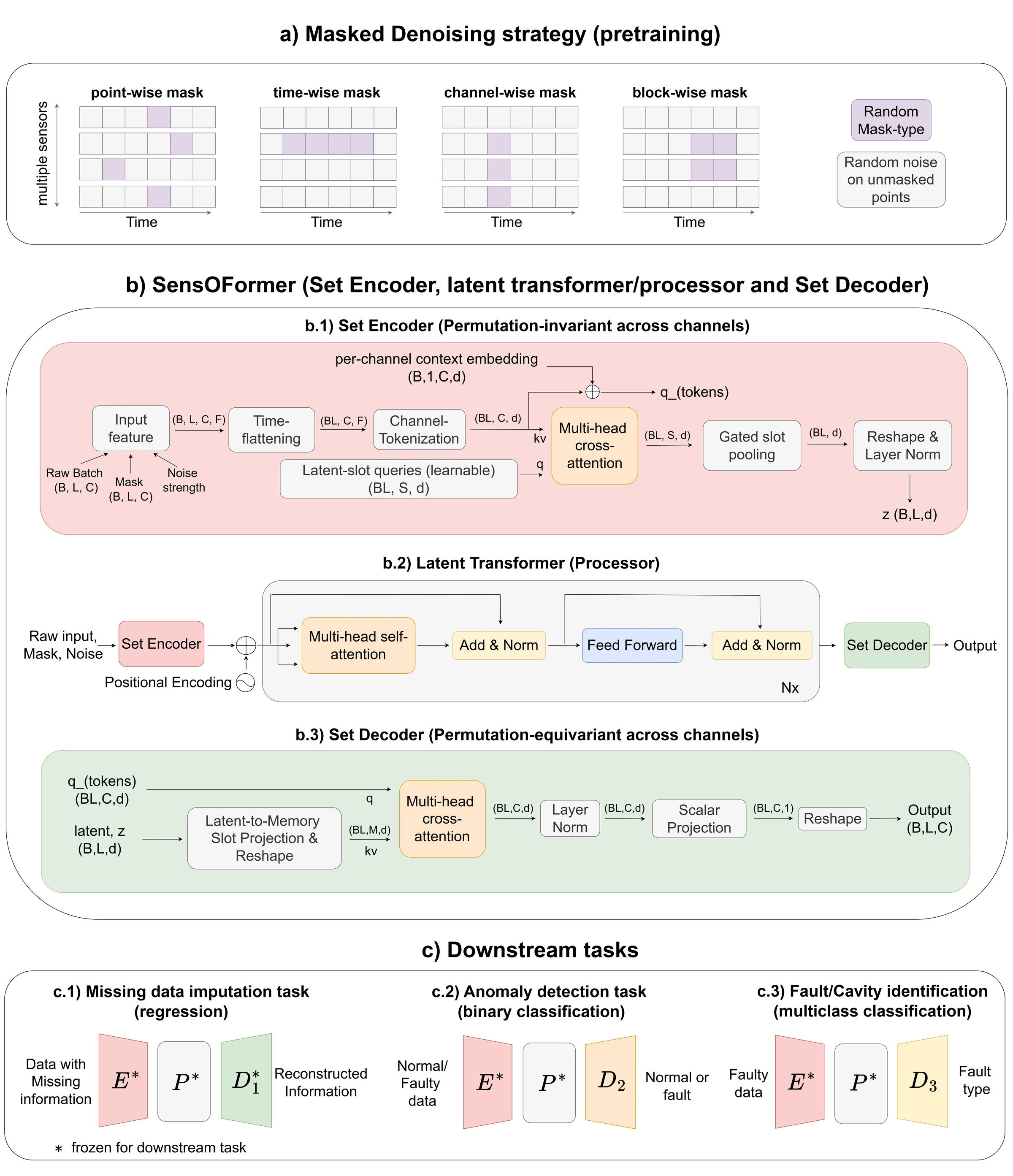
The encoder turns the channels observed at each time step into a compact latent; the processor models time; the decoder preserves the identities of queried output channels. The pretrained encoder–processor backbone is reused for downstream tasks.
16
latent slots
in the set encoder
32
memory slots
in the set decoder
2.38–80.54M
parameters
across five evaluated scales
1,024
time steps
per pretraining window
Scaling behavior
The scaling study asks whether SensOFormer continues to learn better representations as the backbone and pretraining corpus grow. Across five model sizes and four data fractions, validation masked-reconstruction loss decreases along both axes.
The paper summarizes this behavior with a separable power law: one term captures limits from model capacity, while a second captures limits from available pretraining data.
General law · Eq. 7
N is parameter count, D is pretraining-data size, and L∞ is the fitted asymptotic loss.
SensOFormer fit · Eq. 8
The fit uses raw counts for N and D and has RMSE 4 × 10⁻⁴ over the observed configurations.
Interpretation. This is evidence of improvement within the evaluated grid—not a guarantee that the same power law extrapolates beyond it. The practical message is to grow model capacity and accelerator data together.
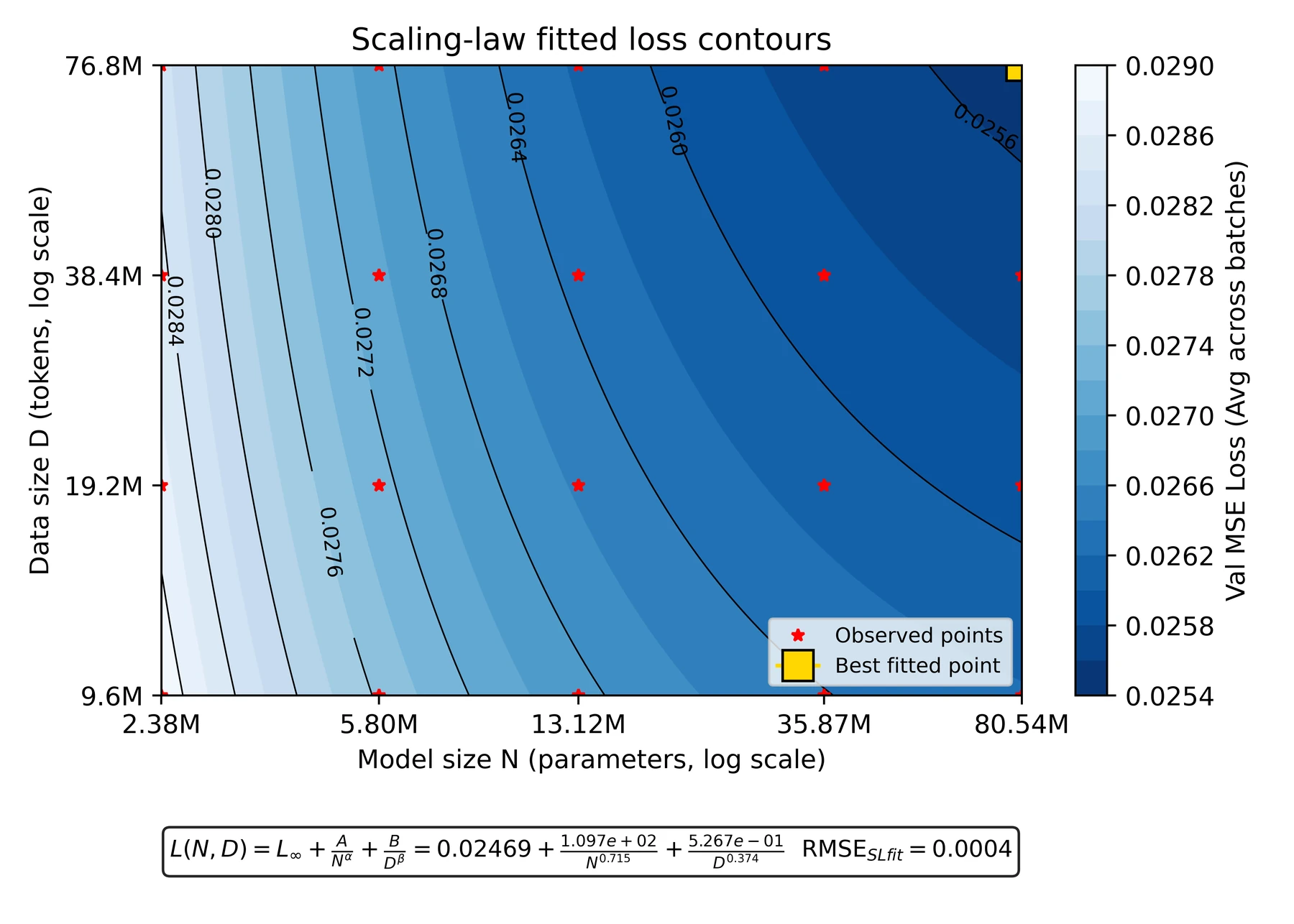
Red markers show evaluated model–data configurations; the yellow marker is the best fitted point within the measured grid.
Pretraining data
SensOFormer learns from five accelerator data families without forcing them into one global channel schema. Each source keeps its own sensors, sequence structure, and operational context.
Five-source corpus
From sequence to training example
Original sequences are divided 90/10 before windowing, so overlapping windows cannot leak across train and validation sets.
Each sequence becomes a 1,024-step window with stride 256; channel counts remain dataset-specific with no channel padding.
Visible values are scaled per window and per channel, using no statistics from the masked targets.
Noise is added only to visible measurements, teaching the model to recover structure instead of copying inputs.
Mask bank · one pattern sampled per window
Together, the masks reproduce isolated dropouts, missing time slices, intermittent sensors, and structured gaps seen in accelerator telemetry.
Zero-shot reconstruction
The paper masks 15% of held-out sensor values and asks the pretrained model to recover them from temporal and cross-channel context. These appendix examples span four accelerator facilities and require no task-specific fine-tuning.
How to read the figures
Blue traces are the recorded sensor values. Red marks identify the values hidden from the model; green circles show SensOFormer-B’s predictions at exactly those locations.
Individual measurements disappear across the window, mimicking scattered dropouts.
A contiguous time–channel region disappears, creating a structured gap.
evaluated dataset–mask settings were led by SensOFormer-B; the smaller SensOFormer-S led the remaining three.
Examples in the sequence
LANSCE · LHC at CERN · SNS at Oak Ridge · LCLS at SLAC
Facility
Mask
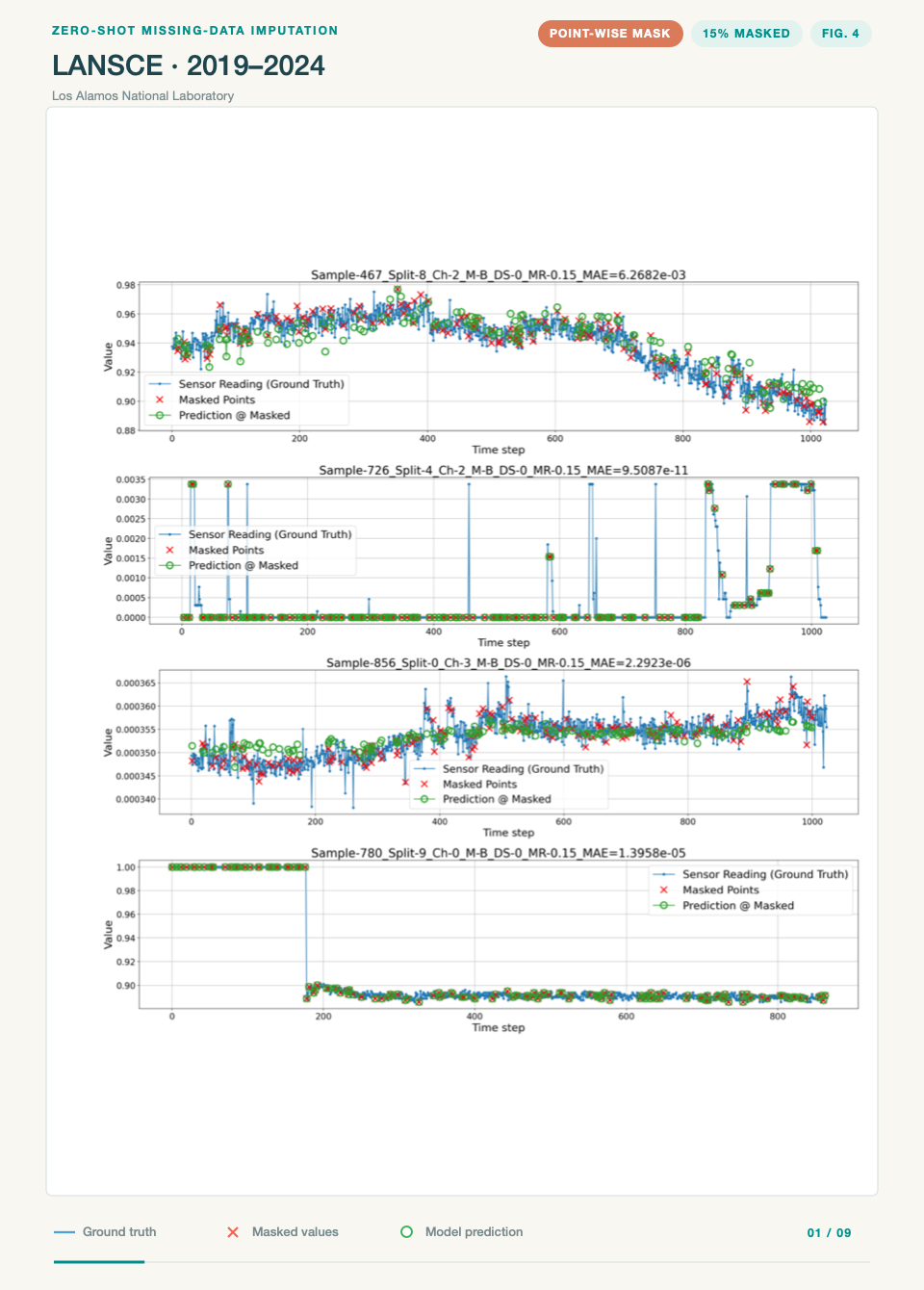
LANSCE · 2019–2024Point-wise mask · Paper Fig. 4
Choose a facility and mask type to inspect the reported examples without waiting for an animation. The explorer includes every qualitative imputation figure in the appendix.
Supervised transfer · CEBAF
Once a faulty event is detected, operators still need to identify what failed. SensOFormer-XTi transfers its pretrained sensor representation to eight CEBAF fault classes using a lightweight temporal classification head.
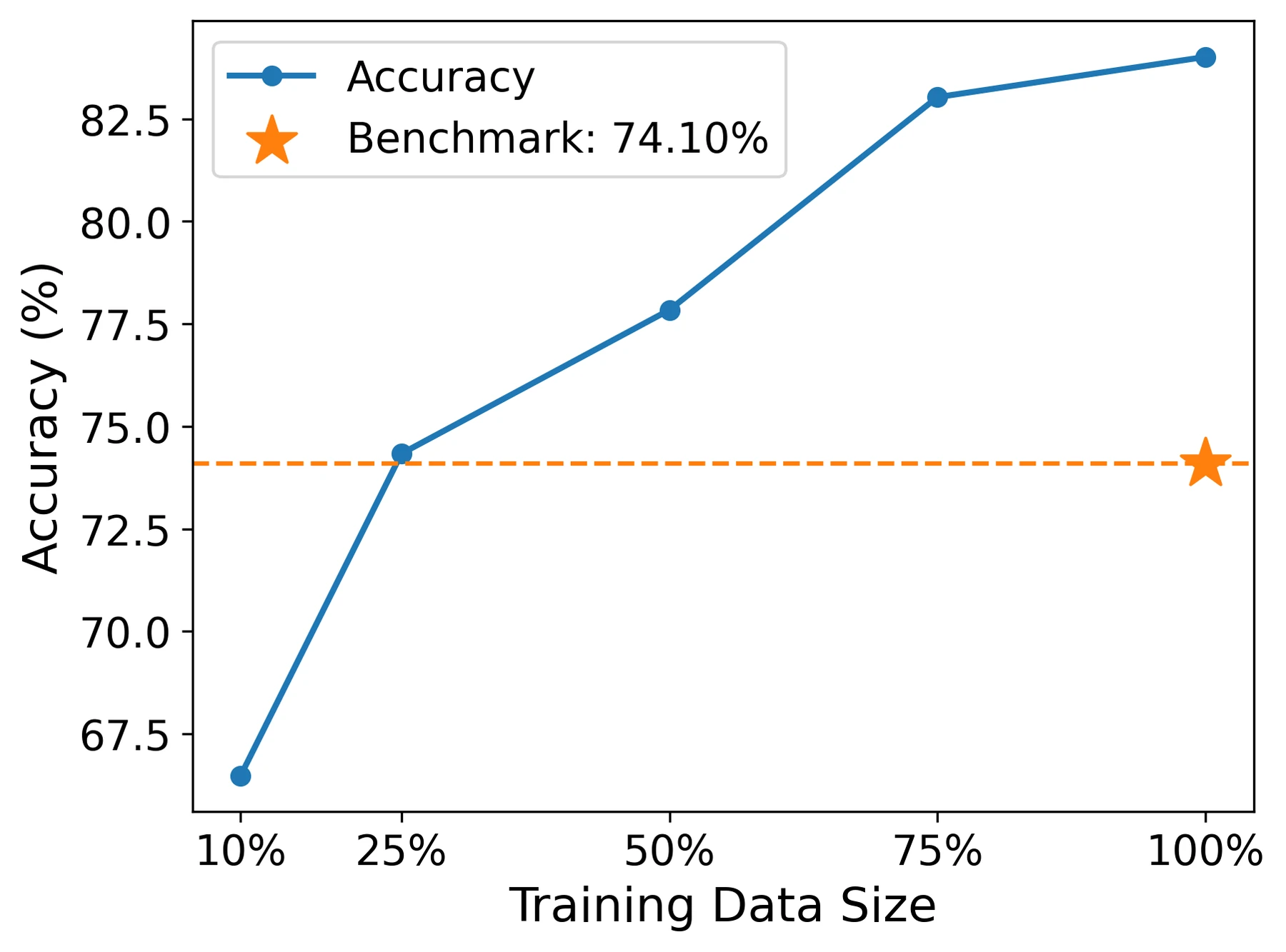
The blue curve is SensOFormer-XTi test accuracy; the orange dashed line marks the 74.10% prior deep-learning benchmark. The held-out test set remains fixed as the labeled training fraction changes.
The label-efficiency result
With only one quarter of the labeled fault examples, the transferred model already moves above the previous benchmark. More labels continue to help, but pretraining makes the scarce-data regime useful much earlier.
Downstream tasks
The pretrained encoder and temporal processor form the shared backbone. SensOFormer either reuses its reconstruction decoder directly or adds a compact task-specific head.
Zero-shot · reconstruction
Recover masked sensor values from temporal and cross-channel context across six held-out test settings. No downstream labels or task-specific training are required.
Frozen backbone · binary head
A 0.22M-parameter temporal CNN head learns normal-versus-faulty HVCM-SNS behavior while the pretrained XTi encoder and processor remain frozen.
Pretrained backbone · multiclass heads
Separate lightweight heads identify the first faulting CEBAF cavity across 9 classes and the fault type across 8 classes. The fault benchmark is surpassed with only 25% of the labeled training set.
Transfer principle: preserve the learned sensor representation; change only the output interface needed by the operational task.