Scientific machine learning
Latent evolution models
Forward and inverse modeling, uncertainty quantification, and tuning of charged-particle beam dynamics in particle accelerators.
Spatiotemporal learning of charged-particle beam dynamics (in particle accelerators)
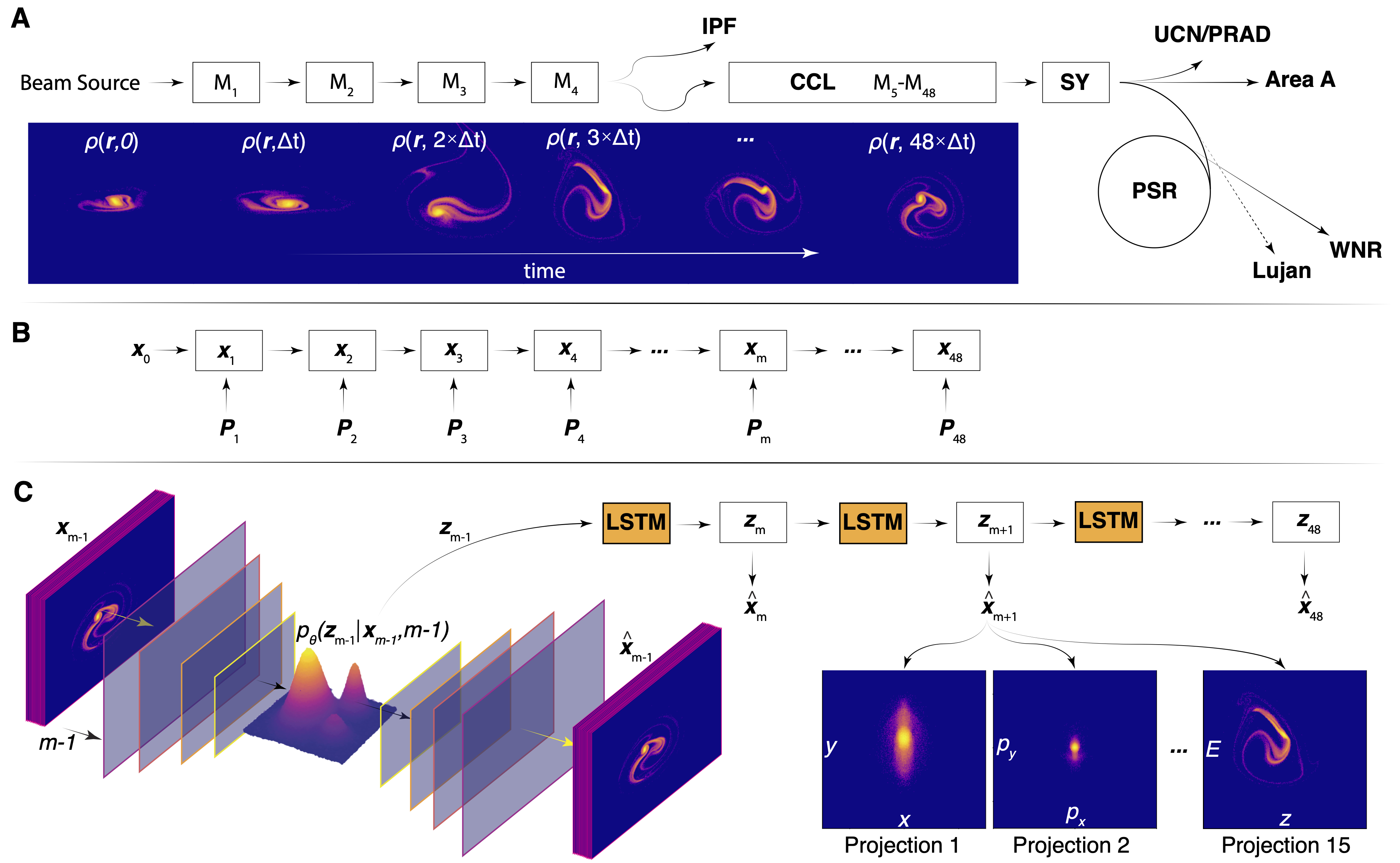
The 6D phase space (x, y, z, px, py, pz) of charged-particle bunches evolves under the influence of electromagnetic fields along the accelerator. This can be viewed as a spatiotemporal dynamical system in which parameters such as RF-cavity amplitude and phase and magnet strength modulate the charged-particle beam.
- In this paper, we propose a two-step unsupervised deep-learning framework called the Conditional Latent Autoregressive Recurrent Model (CLARM) for learning forward spatiotemporal dynamics.
- The model can generate phase space at various accelerator modules by sampling and decoding the structured latent space representation.
- The model also forecasts future states (downstream states) of charged particles from past states (upstream states). Learn more on the project page.
- In this paper, we use a reverse latent evolution model (CLARM is a special case of a broader LEM) to solve the inverse problem of predicting 6D phase-space projections across all upstream sections from downstream phase-space measurements.
- The proposed model also captures the aleatoric uncertainty of the high-dimensional input data within the latent space.
- The uncertainty is propagated through the temporal learner in the latent space to estimate bounds for all upstream predictions, demonstrating robustness to in-distribution variations in the input data.
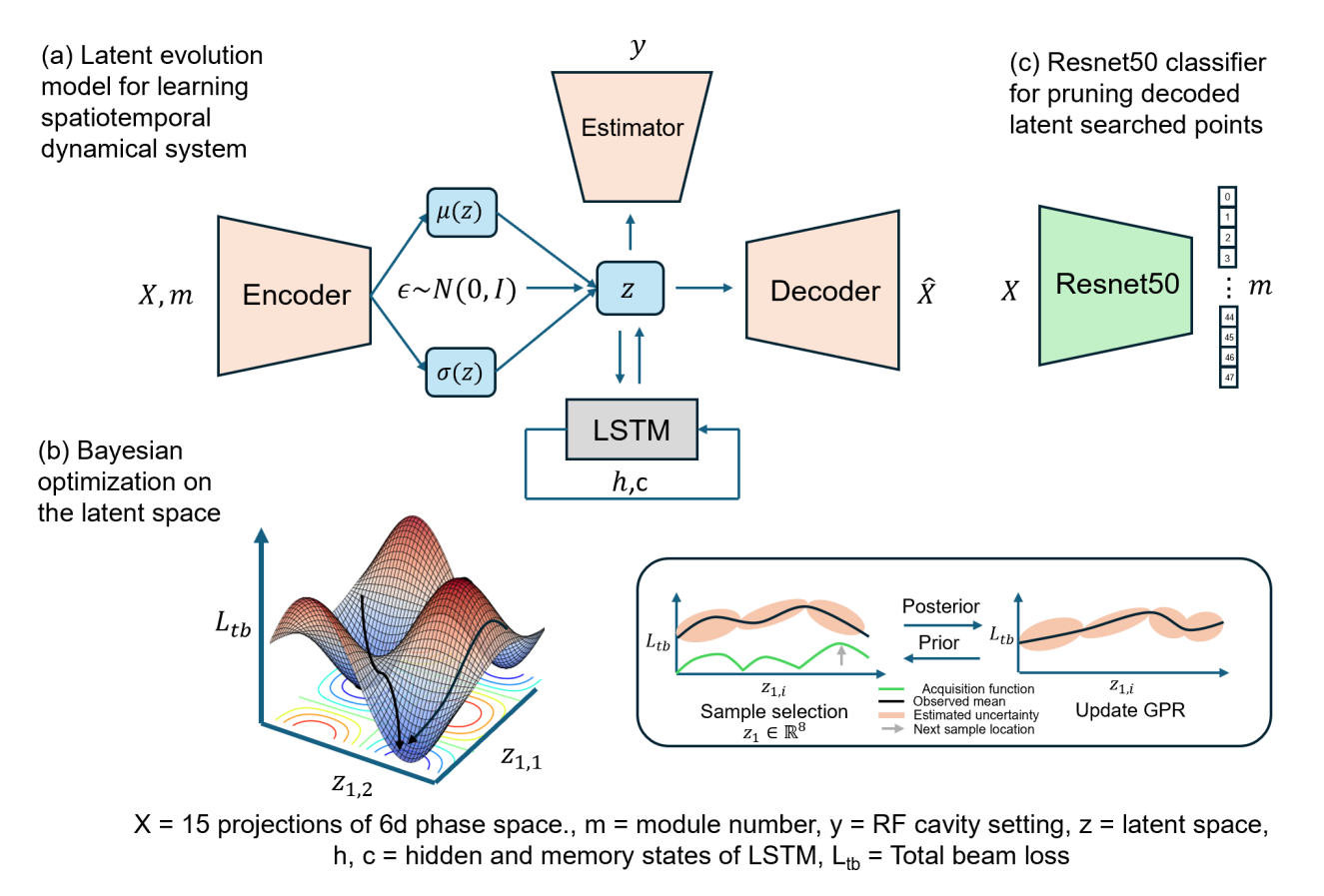
- In this paper, we use a classifier-pruned Bayesian optimizer for efficient exploration within a temporally structured latent space.
- CBOL-Tuner adaptively searches and filters the latent space for optimal solutions (i.e., RF settings for minimal beam loss in the accelerator).
- CBOL-Tuner demonstrates superior performance in identifying multiple optimal settings and outperforms alternative global optimization methods.